
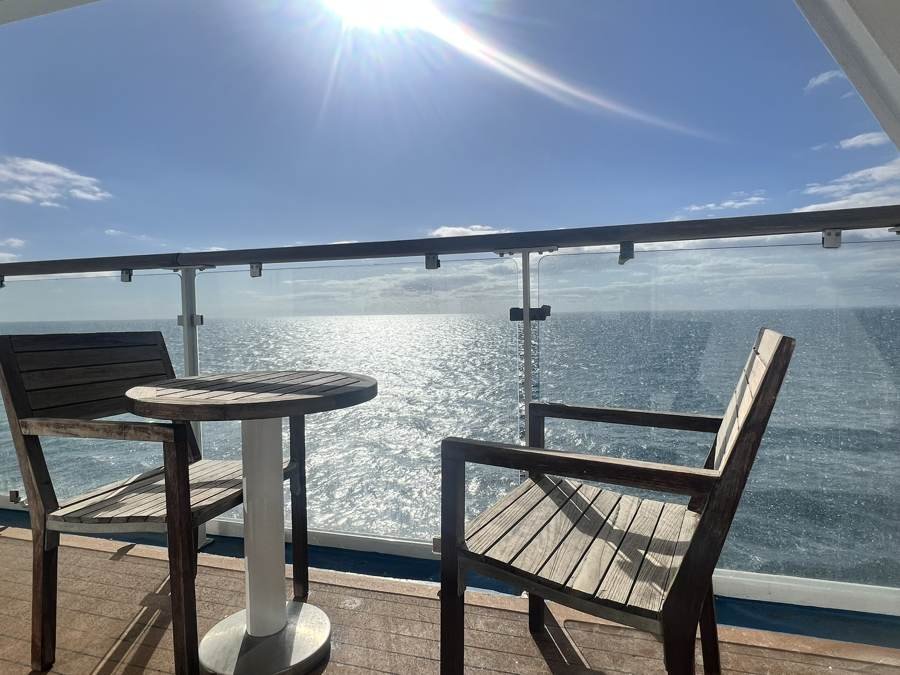
All four direct routes take dogs
Taking your dog on the ferry to Spain
Brittany Ferries carries around 108,000 dogs a year, and the ferry is the only way to get one to Spain without putting it in an aircraft hold. Two things catch people out: the paperwork changed in April 2026, and you cannot leave your dog in the car.
You cannot leave your dog in the car
This is the single most common mistake, and it is made by people who have done it before, because the rule is different depending on where you are sailing.
| Destination | Dogs | Cats |
|---|---|---|
| To Spain | Pet-friendly cabin or onboard kennel only | Pet-friendly cabin only |
| To France | Cabin, kennel, or left in your vehicle | Pet-friendly cabin only |
On every Spanish crossing the car decks are sealed for the duration and nobody goes back down, which is why the vehicle option does not exist. If you have sailed to Roscoff or Cherbourg with the dog in the back before, do not assume the same applies here.
Cats never travel in the car, on any route
A cat must be in a pet-friendly cabin, on every crossing, to France or Spain. There is no kennel option and no vehicle option. If you are moving a cat, the cabin is not a choice you are making, it is a requirement, and those cabins are limited.
Cabin or kennel: what is actually available
Brittany Ferries has increased pet-friendly cabins from 66 in 2019 to 162 across the entire 13-ship fleet, a rise of 145 per cent. That still sounds like more than it is: spread across four Spanish routes and nine French ones, each sailing has only a handful.
Pet-friendly cabins
- A normal cabin, adapted, where the dog stays with you
- 4-berth inside and outside versions on all four Spanish ships
- Costs more than the equivalent standard cabin
- Sell out before any other cabin grade
- The only option if you are travelling with a cat
Onboard kennels
- A dedicated kennel deck, dogs only
- Cheaper than a pet cabin
- You visit at set times rather than staying with the dog
- Fine for a confident dog, hard on an anxious one
- Worth weighing against 33 hours on the Portsmouth routes
Check what is left on your sailing with the special accommodation availability tool before you commit to dates. A cheap fare on a sailing with no pet cabin left is no use to you.
Book when the schedule opens, not when the fare drops
Brittany Ferries releases sailings up to 16 months ahead. Pet-friendly, wheelchair-accessible and Commodore cabins are the first three categories to go, and pet cabins on peak summer sailings can be gone almost immediately. If you are travelling with a dog in August, the booking window matters more than the price.
The paperwork changed on 22 April 2026
If you last took your dog abroad before spring 2026, what you did then will not work now.
Since 22 April 2026, EU pet passports are only issued to, and only valid for, people whose main residence is in the EU. If you live in England, Scotland or Wales, your EU pet passport is no longer accepted at the EU border, regardless of when it was issued.
What you need instead is an Animal Health Certificate (AHC).
What an AHC involves
- Issued by a vet, within 10 days of travel
- Valid for one trip only, so a new one each time
- Costs from around £100 per journey
- Applies to dogs, cats and ferrets, including assistance animals
- Northern Ireland residents still use the passport system
Still required alongside it
- A working microchip, implanted before the rabies jab
- A valid rabies vaccination, meeting EU timing rules
- The vaccination correctly recorded against that microchip
- Any extra conditions the destination country applies
The microchip must predate the rabies vaccination
If the chip went in after the jab, or the vaccination was never recorded against the chip number, a vet cannot issue the AHC. This trips people up at the worst possible moment, because you only find out when you go for the certificate ten days before sailing. Check with your vet well before you book, not the week you travel.
Rules in this area are moving, and there has been talk of Great Britain regaining easier status. Confirm the current position on GOV.UK before you travel rather than relying on any guide, including this one.
Bringing the dog home
Coming back into Great Britain has its own requirement, and it is the one people forget because it happens in Spain.
Dogs must be treated for tapeworm by a vet between 24 and 120 hours before arriving in Great Britain, and the treatment must be recorded. That is a window of one to five days, so on a Spanish trip it means finding a Spanish vet before you sail home. It does not apply to cats or ferrets, and it does not apply on sailings from Ireland.
Find the vet before you need one
If you sail from Santander on a Sunday afternoon, the treatment window opens on the Wednesday before. Work out where the nearest vet to your last stop is while you still have internet and a plan, rather than on a Saturday morning in a town you do not know.
The return sailings from Spain page covers the rest of what changes on the way home, including what you can and cannot bring back.
What the crossing is like with a dog
Check in 90 minutes before departure rather than the usual 45, because pet processing takes longer and the queue for it is separate.
The muzzle rule
- Dogs must be muzzled whenever they are outside the cabin or kennel
- That includes in the port, on board, and in the exercise area itself
- Bring a muzzle the dog is already used to
- Do not plan to buy one at the terminal
What to bring
- Food for the whole crossing, plus a margin
- Bowls, lead, muzzle, waste bags
- Bedding or something that smells of home
- Vaccination records and the AHC, in the car is no good once the decks close
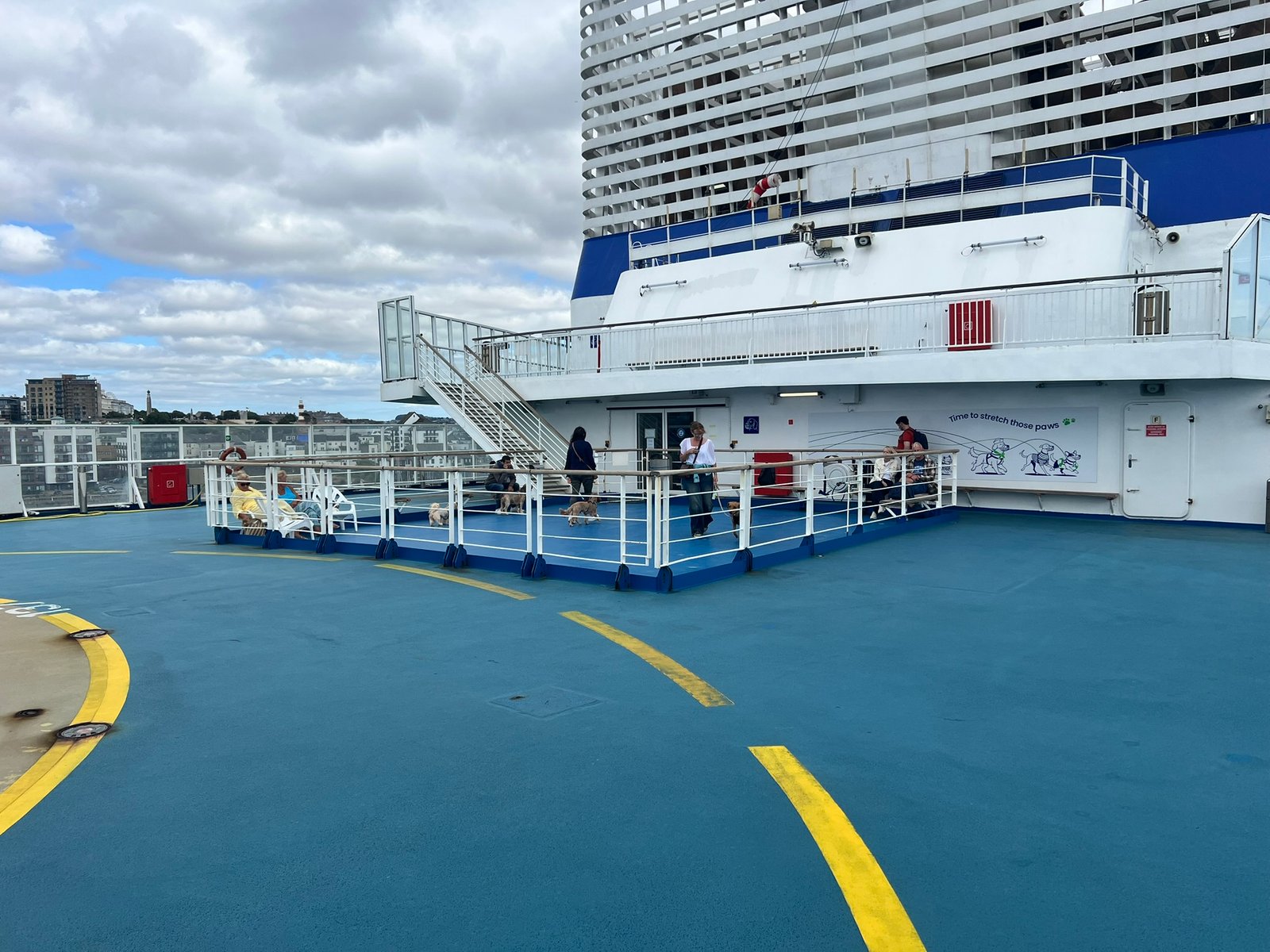
There is an open-deck exercise area on board where dogs can be walked. On the two-night Portsmouth crossings this matters a great deal more than on the single-night Plymouth run, because you are managing a full day at sea as well as two nights.
Which route is best with a dog
All four direct crossings take dogs, and the rules are identical on all of them. The difference is time.
| Route | Time at sea | Nights | With a dog |
|---|---|---|---|
| Plymouth to Santander | 20h 30m | 1 | The clear pick. Shortest by far |
| Rosslare to Bilbao | 27–31h | 1–2 | Best from Ireland, no landbridge |
| Portsmouth to Santander | ~33h | 2 | Year round, but a long time in a kennel |
| Portsmouth to Bilbao | 33–36h | 2 | The longest. Pet cabin strongly advised |
If you are within reach of Devon, Plymouth to Santander is the obvious choice with a dog: it is thirteen hours shorter than the longest option and involves one night rather than two. It is seasonal, running late March to early November, so it is not available in winter.
Worth weighing the alternative honestly. Going via France means a 90-minute Channel crossing where the dog can stay in the car, followed by 800 to 1,250 km of driving with stops. Less time on a ship, far more time in a vehicle, and two extra days each way.
Common questions
Can my dog stay in the car on the ferry to Spain?
No. On all four Spanish routes the dog must be in a pet-friendly cabin or an onboard kennel. The vehicle option exists only on the French crossings.
Do I still need a pet passport?
Not if you live in Great Britain. Since 22 April 2026 you need an Animal Health Certificate, issued by a vet within 10 days of each trip. Northern Ireland residents still use the passport system.
How much does an Animal Health Certificate cost?
From around £100 per journey, and a new one is required for every trip. That is before any vaccination or treatment costs.
Does my dog need anything to come back to the UK?
Yes. Tapeworm treatment from a vet, 24 to 120 hours before arrival in Great Britain, properly recorded. Not required for cats, or on sailings from Ireland.
Are there kennels on board?
Yes, on the Spanish routes, with visiting times rather than unrestricted access. Cats cannot use them.
How early do I need to check in?
90 minutes before departure with a pet, rather than the standard 45.
Can I take more than one dog?
Up to five pets per person travelling non-commercially. Beyond that you need proof they are attending a competition or event.
Check pet cabin availability first
Pet-friendly cabins are the first to sell out. Check before you fix your dates.
Check availability →Pet travel rules change. Confirm the current position on GOV.UK before you travel.