
The alternative to sailing direct
Ferry to Spain via France
A short Channel crossing costs a fraction of the direct sailing to Spain. Then you drive 500 to 775 miles. Here is what that trade actually looks like once fuel, tolls and a night on the road are counted.
Direct to Spain, or via France?
The sea leg is where the two options look wildly different. The total journey is where they converge.
| Direct to Spain | Via France | |
|---|---|---|
| Time at sea | 20 to 36 hours | 90 minutes to 11 hours |
| Driving in Europe | Almost none | 500 to 775 miles |
| Nights on board | 1 or 2, in a cabin | 0 or 1 |
| Nights on the road | None | Usually 1, sometimes 2 |
| Fuel and tolls | Negligible | Substantial, see below |
| Sailing frequency | 2 a week per route | Several a day on short routes |
| Flexibility if plans change | Low | High |
The honest version: it is a swap, not a saving
Going via France moves cost from the ticket to the road. You pay less to the ferry company and more in fuel, tolls, a hotel and two days of your holiday spent driving. Whether that is worth it depends almost entirely on how many people are in the car and how much you dislike driving.
Ferry crossings from the UK and Ireland to France
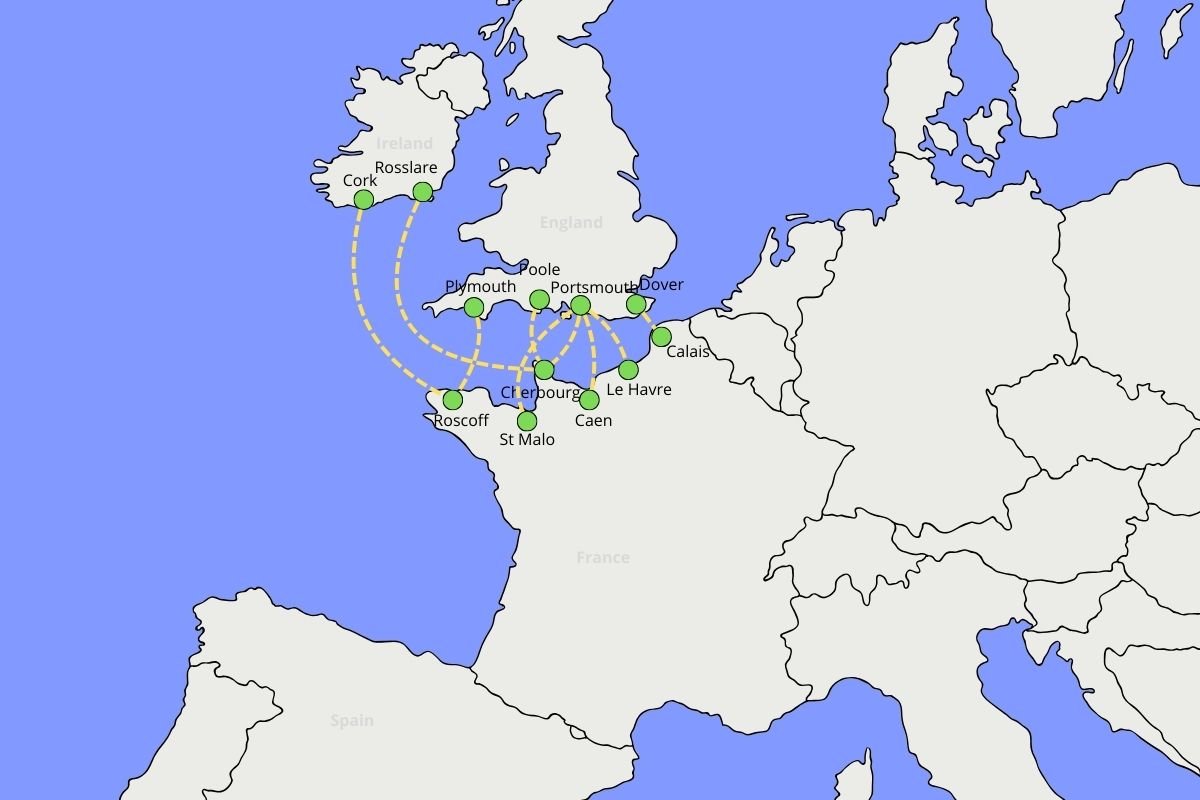
Nine routes, run by Brittany Ferries, DFDS, P&O Ferries, Irish Ferries and Condor. Times vary by season and by whether you take a day or overnight sailing, so treat these as approximate.
| Route | Approx. crossing | Then to Bilbao |
|---|---|---|
| Dover to Calais | 90 minutes | ~720 miles |
| Folkestone to Calais (Eurotunnel) | 35 minutes | ~720 miles |
| Newhaven to Dieppe | 4 hours | ~620 miles |
| Portsmouth to Le Havre | 5 to 8 hours | ~535 miles |
| Portsmouth to Caen | 6 to 7 hours | ~530 miles |
| Portsmouth to Cherbourg | 3 hours | ~560 miles |
| Poole to Cherbourg | 4 to 5 hours | ~560 miles |
| Portsmouth to St Malo | 9 to 11 hours | ~485 miles |
| Plymouth to Roscoff | 6 to 8 hours | ~545 miles |
| Cork to Roscoff | ~14 hours | ~545 miles |
| Rosslare to Cherbourg | ~18 hours | ~560 miles |
Santander is roughly 100 km further west than Bilbao, so add about an hour to every figure in the third column if that is your destination.
Sea conditions on the short crossings
Short Channel routes are more weather-sensitive than the long Biscay sailings, because smaller and faster craft feel a given sea state more than a large overnight ship does. Dover to Calais is the busiest and the one most people default to.
The western ports cut 200 miles off the drive
Everyone thinks of Dover to Calais because it is the cheapest and most frequent. But from Calais you have around 720 miles to Bilbao. From St Malo it is roughly 485 miles, and from Caen or Le Havre about 530. That is three to four hours less driving for a crossing that costs more but also gets you a night’s sleep on the way.
The drive through France
From the Normandy and Brittany ports the route runs south through Rennes or Le Mans, down past Nantes and Bordeaux, and over the border at Irún. From Calais you join it near Rouen or Paris, which is what adds the extra 300 km.
It is motorway almost the whole way and it is fast, but 850 km is still eight to nine hours of driving before breaks. With a full car and children, most people split it with a night somewhere around Bordeaux or Poitiers.
Bordeaux to the Spanish border is about 280 km, roughly two and a half hours, so anywhere south of Bordeaux makes a sensible overnight stop if you want an easy second day.
What the drive actually costs
This is the part the price comparison sites leave out, and it is what closes most of the gap between the two options.
On top of the ferry ticket
- French motorway tolls, roughly £60 to £85 (€70 to €100) each way
- Fuel for 500 to 775 miles, call it £85 to £130
- One night’s hotel, £70 to £130
- Meals on the road for two extra days
- Doubled for the return leg
What you save
- A much cheaper sea crossing
- No two-night cabin to book
- Far more sailing times to choose from
- Easier to change plans late
- You can break the journey wherever you like
Run both totals for your own party before deciding. For two adults travelling light, via France usually wins on cost. For a family of five with a car, the direct crossing is often level or cheaper once a hotel and two days of meals go in, and it costs you two fewer days.
Which one suits your trip
Go via France if
- You want to see something of France on the way
- You are heading for Barcelona, Catalonia or the Med coast rather than the north
- Your dates are fixed and the direct sailings do not fit them
- You are two adults, not a full car
- You genuinely enjoy a road trip
Sail direct if
- You are travelling with children
- You are heading for northern Spain, Madrid or Portugal
- You want the journey to be part of the holiday rather than a transfer
- You would rather not lose two days each way to driving
- You are bringing a motorhome, where fuel and tolls hurt most
All four direct options are compared on the UK to Spain ferry routes page. The shortest is Plymouth to Santander at 20 hours 30 minutes with a single night at sea.
Common questions
Is it cheaper to go to Spain via France?
The ferry ticket is, substantially. The total journey often is not, once you add roughly €70 to €100 in tolls, €100 to €150 in fuel, and a night in a hotel, each way.
How long does it take to drive from Calais to Spain?
Around 1,160 km to Bilbao, which is 11 to 12 hours of driving before stops. Most people split it over two days.
Which French port is closest to Spain?
St Malo, at roughly 780 km to Bilbao. Caen and Le Havre are close behind at around 850 km. Calais is the furthest of the commonly used ports.
Can I take a ferry from France to Spain?
Not directly across the Bay of Biscay as a passenger service. Every Biscay sailing runs from the UK or Ireland. From France you drive over the border at Irún.
Do I need a passport?
Yes, for every passenger including children, on both the French and Spanish legs. Since Brexit an ID card or driving licence is not enough.
Compare against the direct crossings
Four sailings to Spain, no French drive required.
See all UK to Spain routes →Crossing times and distances are approximate and vary by operator, season and sailing.